



When you prepare for an office or facility relocation, the key question is how do I choose a commercial moving company that will protect operations, staff, and assets. In St Petersburg, many businesses start with commercial movers in St Petersburg FL from Karma Movers St Petersburg FL and then compare options using clear, testable criteria.
This guide explains which licenses and insurance matter, how to verify that a mover is legitimate, how many quotes you should collect, and which red flags signal risk. It also covers local considerations for St Petersburg, Clearwater, Largo, Seminole, Gulfport, Pinellas Park, and Tampa.
Table of Contents
Why choosing the right commercial movers matters
Choosing the right commercial moving company matters because your decision affects downtime, safety, data protection, and overall cost. A strong partner helps you relocate in a controlled way, while a poor choice can create delays, complaints, and expensive damage claims.
For businesses, a move is not just about boxes and trucks. It is a temporary reconfiguration of how people, equipment, and records work together. A suitable mover supports that transition by following a detailed plan, communicating clearly, and documenting responsibilities in writing.
How do I choose a commercial moving company?
You choose a commercial moving company by confirming licensing and insurance, checking real business presence and reviews, verifying experience with similar offices, comparing written estimates, and rejecting any provider that will not document scope, pricing, and liability in clear contracts.
A practical approach looks like this:
- Confirm the mover’s legal name, physical address, and contact details
- Check registration and complaint history through federal or state tools
- Request on site walkthroughs for realistic estimates
- Ask for references from offices similar to yours
- Compare written quotes, not verbal ranges only
The Federal Motor Carrier Safety Administration’s Protect Your Move program explains how to verify registration and understand contracts before hiring a mover, and its tools apply to many commercial projects as well as household moves.[^fmcsa]
Defining your office or commercial relocation needs
Before you talk to movers, define your own needs. This step makes every conversation more precise and helps you recognize when a provider is or is not a fit.
Document at least:
- Current and new addresses, floors, and suite numbers
- Department counts and approximate staff numbers
- Number of workstations, private offices, and conference rooms
- Special areas such as labs, studios, or storage rooms
- Critical equipment, servers, safes, or sensitive records
- Desired move dates, acceptable windows, and any blackout days
This information lets you describe your project consistently to every mover and exposes any provider who offers pricing without doing proper homework.

What should I look for in a commercial mover?
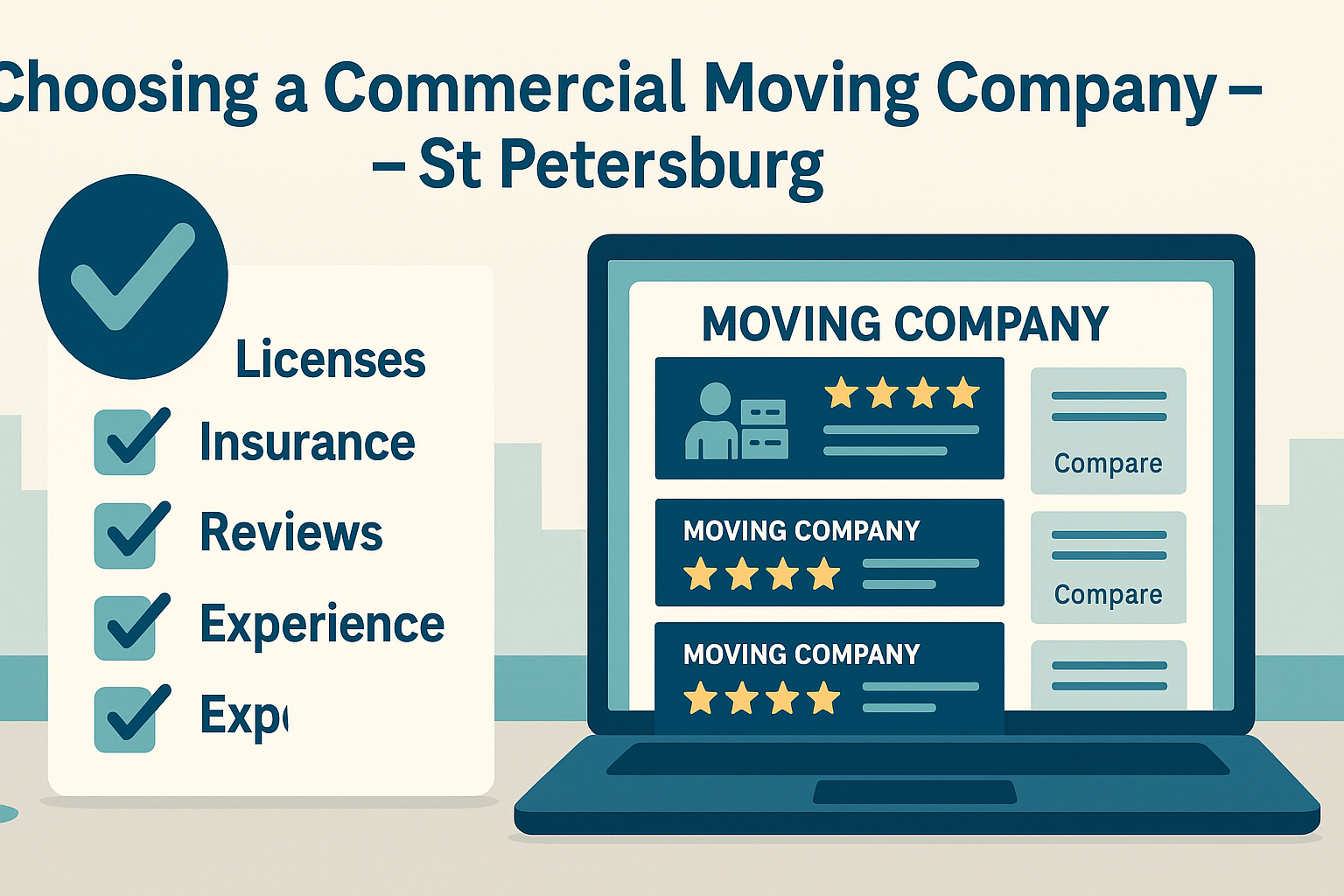
You should look for a commercial mover with valid licensing, clear insurance coverage, documented office moving experience, detailed written estimates, and consistent reviews that show reliable planning, punctuality, and problem solving for business clients in your area.
Key evaluation points include:
- Licensing and registration appropriate to local or interstate work
- Insurance for liability and cargo at levels that satisfy building owners
- Commercial track record with offices, clinics, or warehouses
- Documented processes for inventory, labeling, and communication
- Crew training for safe handling of furniture and equipment
Independent guidance from the Better Business Bureau recommends researching movers, verifying credentials, and getting everything in writing before you commit, which aligns closely with these points.[^bbb]
Matching services to your type of business
Commercial moves are not identical. A professional office, medical clinic, and retail store have different priorities. When you review movers, look for:
- Offices and corporate clients in their portfolio
- Experience with buildings similar to yours, such as mid rise towers or business parks
- Comfort with working after hours or on weekends
- Ability to work alongside your IT and facilities teams
Ask for two or three recent examples of projects similar to your own in St Petersburg or nearby, and ask what challenges emerged and how they were handled.
Essential licenses, insurance, and credentials
Licenses and insurance protect your business when something goes wrong. They also indicate whether a mover is operating within regulatory frameworks.
For a commercial mover serving St Petersburg and the Tampa Bay region, you should expect:
- State registration for intrastate moves where required
- U.S. DOT and FMCSA registration for interstate work
- General liability insurance and cargo coverage
- Workers’ compensation for employees
You can use federal tools from FMCSA’s Protect Your Move resources to confirm registration status and review complaint histories.[^fmcsa2]
Should commercial movers be licensed and insured?
Commercial movers should be properly licensed and insured, because licensing confirms they are authorized to operate and insurance helps cover property damage, injuries, and cargo losses that might occur during packing, loading, transit, or unloading.
In practice, this means:
- Licensing details appear on websites, estimates, and trucks
- Insurance certificates can be sent to you and to building management
- Policy limits satisfy the requirements of your landlord and risk team
Your building manager in St Petersburg, Clearwater, Largo, or Tampa may require the mover to list the property owner as a certificate holder or additional insured. A professional mover is used to this process and can provide documentation without delays.
How do I know if a moving company is legitimate?
You know a moving company is legitimate when it has verifiable registration, a physical business address, consistent branding, clear ownership details, and a track record of public reviews and references that match the name and location shown on official records.
Your verification steps should include:
- Search for the legal business name in state records
- Confirm the address in maps and street level imagery
- Check that phone numbers and emails match across website, invoices, and listings
- Review ratings on established platforms and look for patterns, not single comments
- Ask for at least two references from recent commercial clients
Consumer protection articles note that fraudulent movers often use generic names, virtual offices, and rapidly changing identities, so validating the real entity behind the brand is critical.[^wp]
Using public tools and business organizations
Local and regional organizations can help you vet providers:
- Use FMCSA databases for interstate movers
- Check Better Business Bureau profiles for complaint patterns[^bbb]
- Review listings with the St Petersburg Area Chamber of Commerce or related business groups to confirm local presence[^chamber]
These checks do not guarantee a perfect experience, but they reduce the risk of hiring a company that is difficult to hold accountable.
Evaluating experience with offices and business moves
Experience with office and commercial projects matters more than general household work. You want a mover that understands elevators, loading docks, IT coordination, and staged moves.
When you talk with movers, ask:
- How many office or commercial moves they complete each year
- Whether they have experience in downtown St Petersburg and nearby cities
- How they coordinate with landlords, security, and parking authorities
- How they protect computers, screens, and servers
- Whether they can handle internal moves such as floor to floor changes
Look for specific, concrete examples rather than general claims. A mover that can describe how they handled a recent office relocation in St Petersburg or Gulfport likely has the experience you need.
Comparing commercial moving quotes and services
A quote is only useful when you can compare it fairly to others. Focus on structure, not just totals.
A good commercial moving proposal will:
- Itemize labor, trucks, and materials
- Explain whether pricing is hourly, capped, or flat rate
- Describe which packing tasks are included and which are your responsibility
- List any surcharges for evenings, weekends, or stairs
- Spell out valuation or liability limits
Public consumer guidance from FMCSA and the U.S. Department of Transportation emphasizes getting written estimates and understanding contractual terms before you sign, which applies to office moves as much as to household relocations.[^fmcsa3]
How many quotes should I get for a commercial move?
You should usually get at least two to three detailed commercial moving quotes, because multiple written proposals help you compare scope, staffing levels, assumptions, and exclusions instead of relying on a single estimate or a verbal price range.
When collecting quotes:
- Use the same project description and inventory for each mover
- Request site walkthroughs, not only phone estimates
- Ask each provider to explain how they calculated hours and crew size
- Compare the wording of exclusions and extra charge conditions
If one quote is much lower than others but includes the same scope, explore why. Very low estimates can indicate missing services or unrealistic time assumptions.
Red flags to avoid when hiring commercial movers
Some warning signs suggest you should avoid a mover:
- Requests for large cash deposits before scheduling
- Refusal to provide written estimates or contracts
- No physical address or inconsistent business names
- Pressure to sign quickly without time to review documents
- Unwillingness to provide proof of insurance or references
If you encounter several of these issues in one conversation, move on. St Petersburg and Tampa Bay have multiple providers, so you do not need to accept risky conditions.
Why St Petersburg businesses choose Karma Movers
Many organizations in St Petersburg and nearby cities such as Clearwater, Largo, Seminole, Gulfport, and Pinellas Park look for movers that combine local knowledge with structured planning. Information on Karma Movers St Petersburg FL and its commercial movers in St Petersburg FL page shows how a single provider can handle local office moves, warehouse work, and regional relocations within the greater Tampa Bay area.
Businesses tend to favor movers that:
- Are based in or near the city they serve
- Have experience with common local building types and loading conditions
- Offer both residential and commercial services but clearly distinguish between them
- Provide clear contact details and support channels
Matching these traits with the earlier licensing and verification checks gives you a structured way to choose a commercial moving company in St Petersburg with more confidence.
Practical FAQs on choosing a commercial moving company in St Petersburg
Q: What information should be included in a commercial moving proposal?
A: A solid commercial moving proposal should describe scope of work, crew size, trucks, pricing structure, estimated hours, included materials, schedule assumptions, valuation or liability limits, and any conditions that could increase costs, such as extra trips or additional packing.
Q: How far in advance should I book a commercial moving company in St Petersburg?
A: Many offices should contact movers four to eight weeks before their target date, and larger or multi phase relocations often need additional lead time, especially if you want weekend windows or need to coordinate across St Petersburg, Clearwater, and Tampa locations.
Q: Can we move our office in phases to stay open during the transition?
A: Yes, many businesses use phased moves that relocate non critical departments first and critical teams last, and this approach can reduce downtime but requires tighter planning, more labeling, and clear communication so staff know which location to use on each day.
Q: Who should be on our internal commercial move planning team?
A: A typical planning team includes a project lead, representatives from each department, IT, facilities or maintenance, and sometimes finance or HR, and this group coordinates inventories, communication, building rules, and decision making with the chosen commercial moving company.
Q: Do commercial movers provide packing materials and crates for offices?
A: Many commercial movers supply or rent boxes, labels, and rolling crates as part of their service, and some bundle a set amount of materials into the estimate while others bill them separately, so it is important to confirm quantities, pricing, and how returns are handled.
Q: How can I use reviews without relying only on star ratings?
A: Instead of focusing only on star ratings, read detailed comments that mention office moves, schedule reliability, communication, and how problems were handled, and then compare those themes to the claims in each mover’s proposal and to references they provide.
Q: What should I share with building management once I choose a mover?
A: Share the mover’s name, contact details, insurance certificates, proposed dates and times, and any special equipment they will use, and coordinate elevator reservations, loading dock access, parking, and security procedures for both the origin and destination buildings.
Schedule your commercial moving consultation in St Petersburg
To put these criteria into practice, choose a short list of movers and request on site consultations. For St Petersburg, Clearwater, Largo, Seminole, Gulfport, Pinellas Park, and Tampa, you can start by reviewing the commercial movers in St Petersburg FL service page and related moving company services in St Petersburg. Use the checklists in this guide alongside authoritative resources from FMCSA and the Better Business Bureau to confirm that any commercial moving company you select is properly licensed, insured, and prepared to handle your office relocation with documented, transparent processes.