

Many people search for clear answers to “do movers pack your stuff” when planning a relocation. Karma Movers St Petersburg FL provides moving and packing services in St Petersburg, FL, and this guide explains how professional packers work, what they handle, and what you still need to manage yourself.
Understanding how packing services are structured helps you choose the right level of help, avoid misunderstandings on moving day, and protect your belongings. The information below applies to local and long distance moves and is based on common industry practice plus official guidance from consumer protection agencies. (FMCSA)
Table of Contents
Do movers pack your stuff?
Most full service movers will pack your stuff if you purchase a packing service, either full or partial. Standard moving quotes often include loading and transport only, so packing is added as an extra service that covers labor, materials, and time.
In practice, packing services are offered in three main formats:
- Full packing, where the crew packs almost everything in the home.
- Partial packing, where they handle only selected rooms or fragile items.
- Owner packed, where you pack yourself and movers focus on loading and unloading.
The exact scope is defined in the written estimate or service agreement. You should always confirm whether your quote includes packing labor, packing materials, or both, and how any additional time is billed.
Professional movers also usually follow specific packing standards designed to limit damage and clearly identify boxes by room and contents. Those standards are often aligned with best practices used by regulated household goods carriers. (FMCSA)
Full service vs self packing
Full service packing means the crew supplies materials, packs agreed items, and prepares furniture for transport. Self packing means you provide your own boxes and materials and do most or all of the packing before moving day.
Key differences include:
- Time investment
- Full service packing reduces your personal time commitment.
- Self packing requires several days or weeks of effort before the move.
- Packing quality and consistency
- Trained packers follow repeatable methods and use standard carton sizes.
- Self packed boxes can vary in weight and protection, which may affect handling.
- Cost and risk trade off
- Full service packing costs more upfront but can reduce breakage and claims.
- Self packing is cheaper if done carefully, but poor packing can lead to damage.
Some customers choose a mixed approach, such as professional packing for kitchens, glass, and artwork, and self packing for clothing, books, and non breakable items.
Do movers pack your clothes and closets?
Most movers will pack clothes and closets if this is included in your packing service. Hanging garments are usually moved in wardrobe cartons, and folded clothes are packed in standard boxes or left in sturdy drawers if the furniture can be handled safely.
In practical terms, clothing packing usually looks like this:
- Hanging clothes are transferred directly from your closet to tall wardrobe boxes.
- Folded clothing is placed in medium boxes or small containers for heavy fabrics.
- Shoes can be boxed separately or combined with clothing if wrapped to prevent scuffs.
- Seasonal or rarely used items can be grouped for easier long term storage.
Movers may decline to pack closets that contain loose valuables, important documents, or mixed items such as cosmetics, liquids, and breakables. It is best to empty closets of anything fragile, hazardous, or irreplaceable before moving day.
You can speed up the process by grouping clothing by family member and season, removing unused items, and clearly marking any boxes that should be unpacked first in the new home.
Will movers pack everything or only boxes?
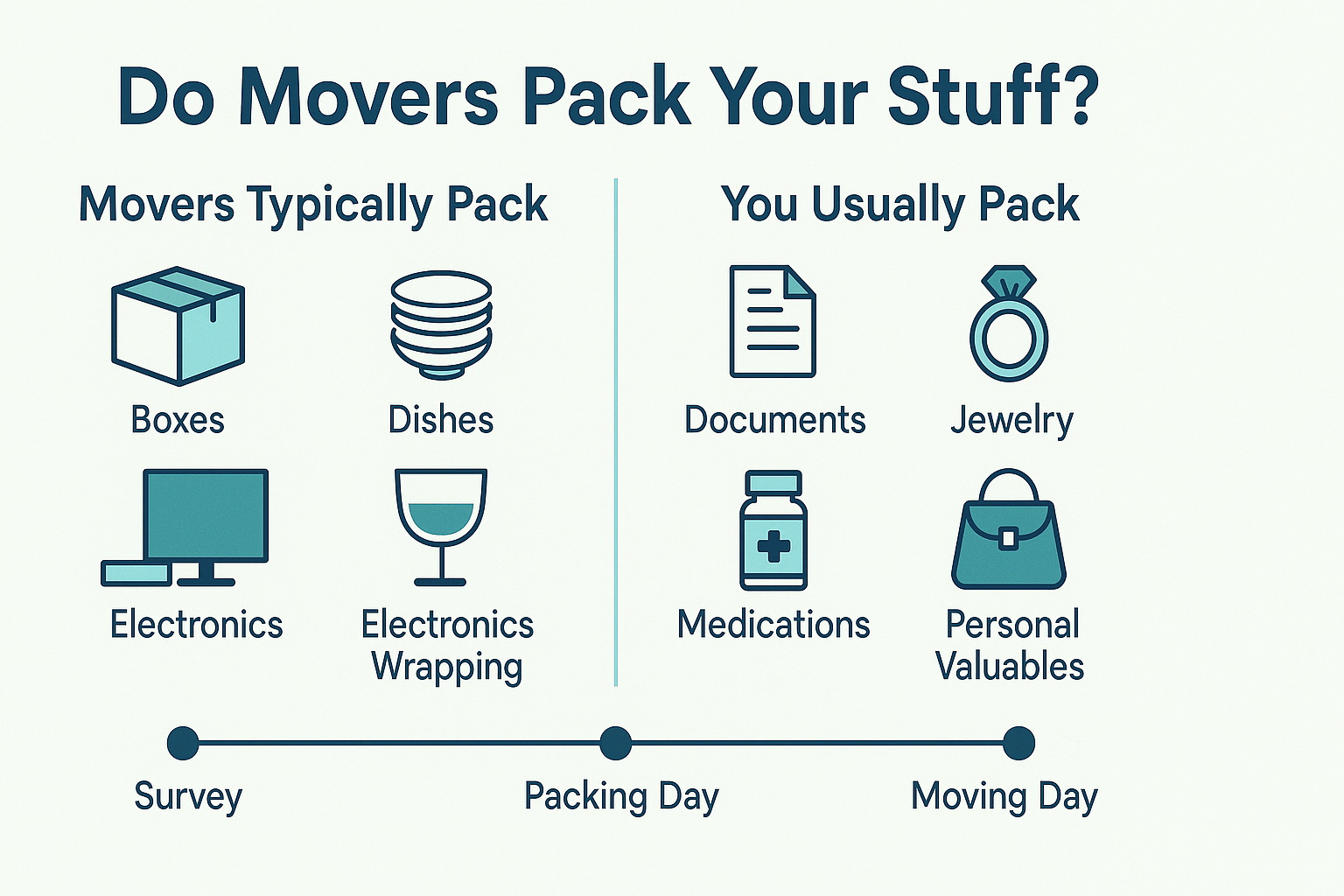
Movers do not automatically pack everything in a home. They typically pack items that meet three conditions: the items are covered by your service level, they are safe to transport under regulations, and they can be reasonably protected with available materials.
In a standard full packing service, movers usually handle:
- Everyday household goods such as dishes, cookware, books, toys, and decor.
- Clothing, linens, and soft goods that can be boxed or bagged.
- Most small appliances and electronics that fit in cartons.
- Furniture that can be wrapped, padded, or disassembled safely.
However, there are always exclusions. Most movers will not pack hazardous materials, perishable food, or certain high value and irreplaceable items. (Karma Movers)
You should review your estimate to see whether:
- Packing labor is limited to a specific number of hours.
- Only a certain number or size of boxes are included.
- Specialty services such as crating or custom packing are billed separately.
Clarifying these details before moving day prevents disputes about what is covered and what will be billed as extra.
What movers typically pack for you
Fragile and high value items
Professional movers are trained to pack fragile and high value items in a way that limits movement inside the box and spreads weight across multiple layers of protection.
Common techniques include:
- Using dish barrels and cell dividers for glasses and stemware.
- Double boxing very delicate items such as fine china or collectibles.
- Wrapping frames, mirrors, and artwork with paper and bubble wrap.
- Filling voids in boxes with crushed paper to prevent shifting.
You should tell the crew which items are especially valuable so they can assign extra padding or suggest custom crating where needed.
Furniture, appliances, and bulky items
Movers usually wrap large furniture with padded blankets and secure them with stretch film or tape. This helps prevent scratches, dents, and fabric damage while pieces are carried through doorways or loaded into the truck.
Typical steps include:
- Removing loose components such as shelves, glass panels, or hardware.
- Padding corners and exposed edges.
- Protecting upholstery with plastic or clean moving pads.
- Securing doors and drawers so they do not open during transport.
Appliances such as refrigerators, washers, and dryers must be disconnected, drained, and cleaned before movers can safely wrap and load them. For gas appliances and hard wired connections, licensed technicians are often required.
Do movers disassemble furniture and pack it?
Many movers will disassemble standard furniture and pack it when required for safe handling, as long as this task is included in the work order. Simple items like bed frames, table legs, and modular shelving are commonly taken apart and reassembled.
Typical practice includes:
- Taking down beds, headboards, and bunk frames that do not fit through doors.
- Removing legs from dining tables if necessary to prevent damage.
- Separating sectional sofas when they are too bulky to carry as one piece.
- Detaching mirrors from dressers and wrapping them separately.
More complex disassembly, such as large wardrobes, built in units, or high end office furniture, may require extra time and sometimes specialty tools. Some movers treat this as a billable add on, so it is important to confirm scope and cost during the survey.
You can reduce time on moving day by emptying furniture, removing personal items from drawers, and keeping all screws, bolts, and hardware together in labeled bags taped to the relevant piece.
What you may need to pack yourself
Even when you buy packing services, movers commonly ask you to handle some categories of items yourself. The reasons include safety regulations, insurance limits, and practical concerns about access and documentation. (Surface Transportation Board)
Items you may be expected to pack or move personally include:
- Important documents
Passports, financial records, medical files, and legal documents are usually safer in your own vehicle. - Jewelry, cash, and small valuables
Many carriers exclude these from standard liability coverage and recommend personal transport. - Prescription medications and medical devices
These should stay with you in case of delays, access needs, or temperature concerns. - House plants and perishable food
Most movers will not accept living plants or refrigerated items for longer trips. - Hazardous or restricted items
Examples include flammables, compressed gas, certain cleaning chemicals, and ammunition.
If you are unsure about a specific category, ask the estimator or move coordinator well in advance and request written guidance.
How early do movers start packing on moving day?
For most local residential moves, movers start packing on moving day in the morning, often between 8 a.m. and 10 a.m., based on your booking window. Larger homes or full packing jobs may require a separate packing day before the truck arrives.
Several factors affect the start time and duration:
- Size of the home and volume of belongings.
- Whether packing and loading occur on the same day.
- Travel time from the mover’s warehouse to your address.
- Building rules for elevators, dock access, or quiet hours.
If your home is large or access is complex, the company may send the packing crew a day early so that loading can start on time. Ask for a realistic schedule that explains how many workers will be on site and how long they expect each phase to take.
To prepare, clear driveways and hallways, reserve elevators if needed, and keep children and pets away from work areas so the crew can move efficiently.
How moving and packing services work in St Petersburg, FL
In St Petersburg and the wider Pinellas County area, customers typically book moving and packing services with a combined quote that covers:
- Packing labor and materials.
- Loading and transport within or beyond the metro area.
- Unloading and basic placement of furniture in the new home.
Local moves tend to be priced based on crew size and time, while longer distance moves may factor in shipment weight and mileage. (FMCSA)
Long distance movers in St Petersburg FL usually retain similar packing standards but need additional documentation and scheduling because travel times and legal requirements differ from purely local work.
For customers near city boundaries, it is common to combine packing in St Petersburg with delivery to nearby locations such as:
- Gulfport
- Pinellas Park
- Largo
- Clearwater and Clearwater Beach
- Treasure Island and St Pete Beach
- Seminole and surrounding neighborhoods
When planning a move that crosses county or state lines, check how the mover handles delivery windows, storage in transit, and liability for delayed shipments.
When to hire Karma Movers for packing help
Hiring professional packers is most useful when any of the following applies:
- You have limited time to prepare before a firm move date.
- There are many fragile, oversized, or high value items.
- Physical limitations make extensive lifting and bending difficult.
- You are coordinating a move alongside work, family, or medical obligations.
Karma Movers St Petersburg FL offers full and partial packing options that can be tailored to situations such as apartment moves, single family homes, senior relocations, or small offices. The same crews also handle loading, transport, and unloading to simplify coordination.
If you prefer to pack some items yourself, you can still request professional help for a single room such as the kitchen or for specific categories like artwork and electronics. This is often a practical balance between cost and risk.
Customers who are unsure about the right level of service can request a walk through or virtual survey so that the company can estimate packing time, materials, and any special handling.
In depth answers about professional packing services
Q: How far in advance should I book packing services?
A: For most local moves, booking packing services two to four weeks in advance is usually enough. Larger homes, peak season dates, or complex moves benefit from a longer lead time of four to eight weeks so materials and crews can be scheduled properly.
Q: Can movers pack only one room or a small apartment?
A: Yes, many movers offer partial packing such as one room, a studio, or only fragile items. The crew is usually billed by the hour with a minimum time block, so a focused packing job can be cost effective for smaller spaces or specific problem areas.
Q: Do I need to be home while movers pack my belongings?
A: Someone who can answer questions and authorize decisions should be present during packing. This does not have to be every adult in the household, but at least one responsible person should stay available to confirm what is packed, where items go, and how to handle valuables.
Q: What should I do before movers arrive to pack?
A: Before movers arrive, remove trash, set aside items you will move yourself, and unplug or empty appliances. Group similar items together, label “do not pack” areas, and make sure pathways are clear. This preparation reduces confusion and keeps packing efficient and organized.
Q: How long does it take movers to pack a typical home?
A: Packing time depends on crew size and home contents, but many three bedroom homes take one full day for a three or four person crew. Very full homes, homes with stairs, or extensive fragile items can take longer, while small apartments may be packed in a few hours.
Q: Are tips for packers required or optional?
A: Gratuities are optional and are not required under any regulation. Some customers choose to tip crews after a smooth job, often based on effort and service quality. If you decide to tip, cash is common, and it is usually divided among the crew members.
Q: What insurance covers items that movers pack?
A: When movers perform the packing, those items are typically covered under the company’s standard valuation or optional full value protection, subject to limits and exclusions. It is important to read the written terms and ask about coverage levels, deductibles, and claim procedures in advance.
Request a packing and moving quote in St Petersburg FL
If you want professional help with packing, the next step is to request a clear written quote that separates packing labor, packing materials, and transport. You can start by contacting Karma Movers St Petersburg FL or using the company’s contact page to schedule a survey.
During that conversation, ask the estimator to:
- Confirm whether full or partial packing is included.
- List which rooms and item types are covered.
- Explain any exclusions or items you must handle yourself.
- Outline the planned schedule for packing and loading.
By aligning expectations early, you can decide whether movers should pack some, most, or all of your belongings and plan a move from St Petersburg, FL, and nearby areas that is efficient, safe, and transparent on cost.